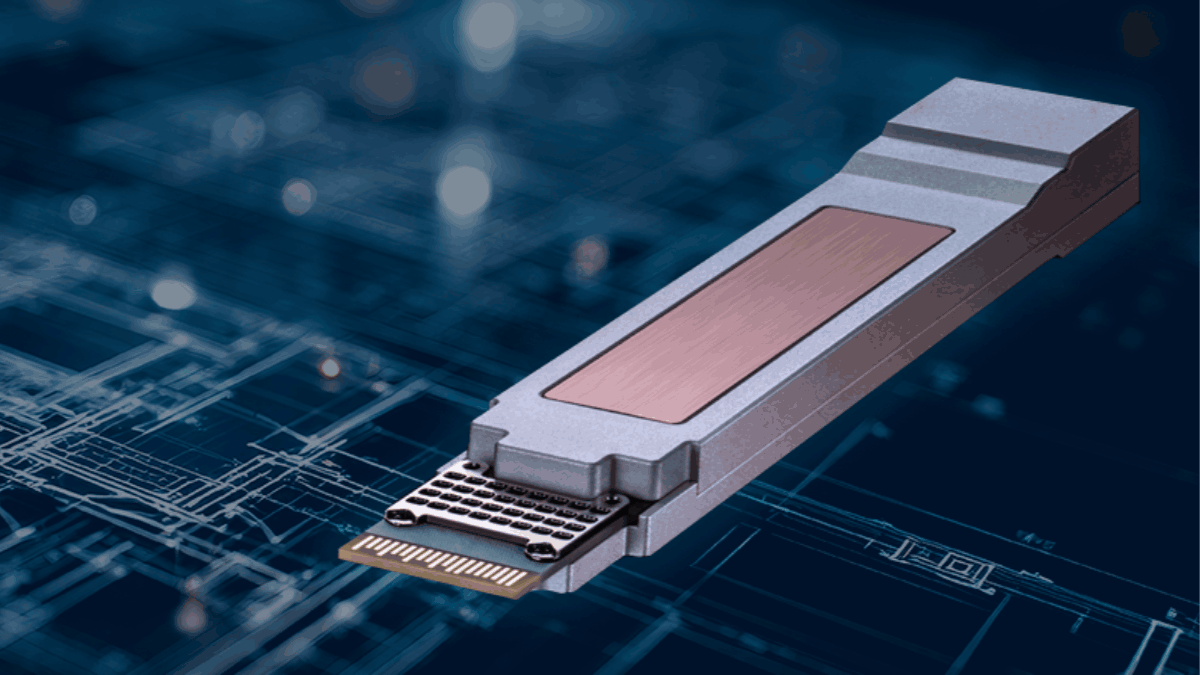
New Transceivers Enable AI Builders to Scale Compute Within the Same Network Footprint While Reducing Networking’s Share of the Power Budget
News Summary:
- Ultra-Dense Small Form Factor Pluggable (USFP) is designed to be the first module to support 400Gb/s-per-lane electrical signals, enabling capacity up to 12.8Tb/s, so AI factory builders can scale Ethernet AI fabrics, while extending a proven deployment model across multiple generations of data center networks.
- USFP delivers 4x the bandwidth density and 1.3x the power efficiency of 200Gb/s-per-lane optics so AI factories can connect more computing systems without adding network tiers, while using less power to move each bit of data.
- NVIDIA and Cisco are working with TE Connectivity and Amphenol to build a multi-source hardware ecosystem around USFP.
SANTA CLARA, Calif.—OCP—Oct. 12, 2026—NVIDIA and Cisco today announced plans for Ultra-Dense Small Form Factor Pluggable (USFP), a new high-density 400Gb/s-per-lane optical module designed to equip the hardware ecosystem for the next generation of AI factories using pluggable transceivers.
As AI models grow and inference demand expands, AI factories must connect more computing systems while managing network complexity, power and costs. Moving more data per watt and per switch helps operators make better use of their infrastructure investments.
Scaling AI factories requires more bandwidth per connection and more connections per switch. When a switch reaches its capacity, further network expansion can require additional switch layers and optical links, increasing latency, power consumption and costs.
USFP is designed to enable AI factory builders to scale from 200 Gb/s per lane to 400Gb/s-per-lane Ethernet AI fabrics, while extending a deployment model proven at scale across multiple generations of data center networks. With USFP, customers can embrace next-generation optical technology and meet the performance demand of AI workloads without overhauling their data center infrastructure.
The first planned USFP-based transceivers will pack 16 full-duplex lanes in an octal small form factor (OSFP)-sized footprint supporting both switches and SuperNICs, with the ability to expand to 32 and more lanes in the future. By doubling both the lane count and bandwidth per lane, USFP enables AI fabrics to connect more 1.6Tb/s endpoints without adding network tiers. Customers will be able to achieve 12.8Tb/s of overall capacity with USFP.
Comparable with an OSFP-sized module, it delivers 4x the bandwidth and front-panel bandwidth density, with approximately 1.3x the power efficiency, versus 200Gb/s-per-lane pluggable modules. This means AI builders can increase their compute scale within the same network footprint, while decreasing networking’s share of the overall AI factory power budget.
“Building the world’s largest AI factories starts with rethinking the smallest of connections,” said Gilad Shainer, senior vice president NVIDIA. “With USFP, NVIDIA and Cisco are building an ecosystem to reinvent pluggable optics — connecting more computing with greater efficiency to power the next generation of AI factories.”
“AI builders need an interconnect architecture that can scale performance without locking them into a more complex operating model,” said Bill Gartner, senior vice president and general manager of optical systems and optics at Cisco. “Cisco and NVIDIA recognized that scaling pluggable optics to 400Gb/s per lane would require more than another incremental extension of today’s module designs. Through our collaboration, USFP is designed to deliver a new level of bandwidth density while preserving the serviceability, deployment flexibility and operational simplicity of pluggable optics. By taking a full-stack approach — from silicon and systems to optics and the network operating system — we can optimize every layer to deliver the performance and scale the next generation of AI networks will require.”
More AI Infrastructure From Every Switch
Designed for electrical signals of 400Gb/s per lane, USFP uses a new two-dimensional array connector with a two-step insertion design that engages high-speed contacts after the module is inserted, reducing contact wear, improving signal integrity and making insertion force more predictable. The connector technology allows for further scaling of lane count to 32 full duplex lanes and more in the future. Because the connector is designed for 400Gb/s performance, it also offers improved performance at 200Gb/s per lane.
USFP supports power dissipation of up to 100 watts without needing a separate, dedicated embedded cooling circuit within the transceiver, reducing switch design complexity and improving reliability. Together, these capabilities enable higher-bandwidth fabrics while preserving the mature deployment, serviceability and manufacturability of existing pluggable transceivers.
All USFP configurations support optical designs that reduce latency and power consumption by simplifying signal processing. Support for a broad range of optical technologies and connection distances gives system designers the flexibility to meet unique AI factory deployment needs.
A Hardware Ecosystem for Next-Generation AI Factories
NVIDIA and Cisco are collaborating with TE Connectivity and Amphenol to build USFP cages, connectors and modules, with additional partners expected to join. The shared form factor gives suppliers a common foundation for developing high-density pluggable infrastructure for 400Gb/s-per-lane fabrics to build a robust ecosystem for AI factory builders.
The collaboration builds on NVIDIA and Cisco’s existing work to ensure NVIDIA Spectrum-X Ethernet networking and Cisco Silicon One-based Ethernet networks work together seamlessly, simplifying AI infrastructure deployment for enterprises, neoclouds and sovereign clouds.
NVIDIA and Cisco plan to create an open industry specification for USFP through an upcoming community-led multi-source project.
Supporting Resources:
- Executive Blog Post: Cisco and NVIDIA Announce USFP: Expanding the Path to AI Connectivity
- Also from OCP Global Summit 2026: Cisco Advances Scalability and Openness at OCP 2026
About NVIDIA
NVIDIA (NASDAQ: NVDA) is the world leader in AI and accelerated computing.
About Cisco
Cisco (NASDAQ: CSCO) is the worldwide technology leader that is revolutionizing the way organizations connect and protect in the AI era. For more than 40 years, Cisco has securely connected the world. With its industry leading AI-powered solutions and services, Cisco enables its customers, partners and communities to unlock innovation, enhance productivity and strengthen digital resilience. With purpose at its core, Cisco remains committed to creating a more connected and inclusive future for all. Discover more on The Newsroom and follow us on X at @Cisco.
Cisco and the Cisco logo are trademarks or registered trademarks of Cisco and/or its affiliates in the U.S. and other countries. A listing of Cisco's trademarks can be found at www.cisco.com/go/trademarks. Third-party trademarks mentioned are the property of their respective owners. The use of the word partner does not imply a partnership relationship between Cisco and any other company.
Forward-Looking Statements
This press release may be deemed to contain forward-looking statements, which are subject to the safe harbor provisions of the Private Securities Litigation Reform Act of 1995. These forward-looking statements include, among other things, statements regarding establishment of a USFP MSA and expected benefits thereof.
Readers are cautioned that these forward-looking statements are only predictions and may differ materially from actual future events or results due to a variety of factors, including: business and economic conditions and growth trends in the networking industry, our customer markets and various geographic regions; global economic conditions and uncertainties in the geopolitical environment; overall information technology spending; the growth and evolution of the Internet and levels of capital spending on Internet-based systems; reliance on new product introductions and acceptable market acceptance of those new products; and other factors listed in Cisco's most recent reports on Form 10-K and Form 10-Q filed with the SEC. Any forward-looking statements in this release are based on limited information currently available to Cisco, which is subject to change, and Cisco will not necessarily update the information.
Media Contacts