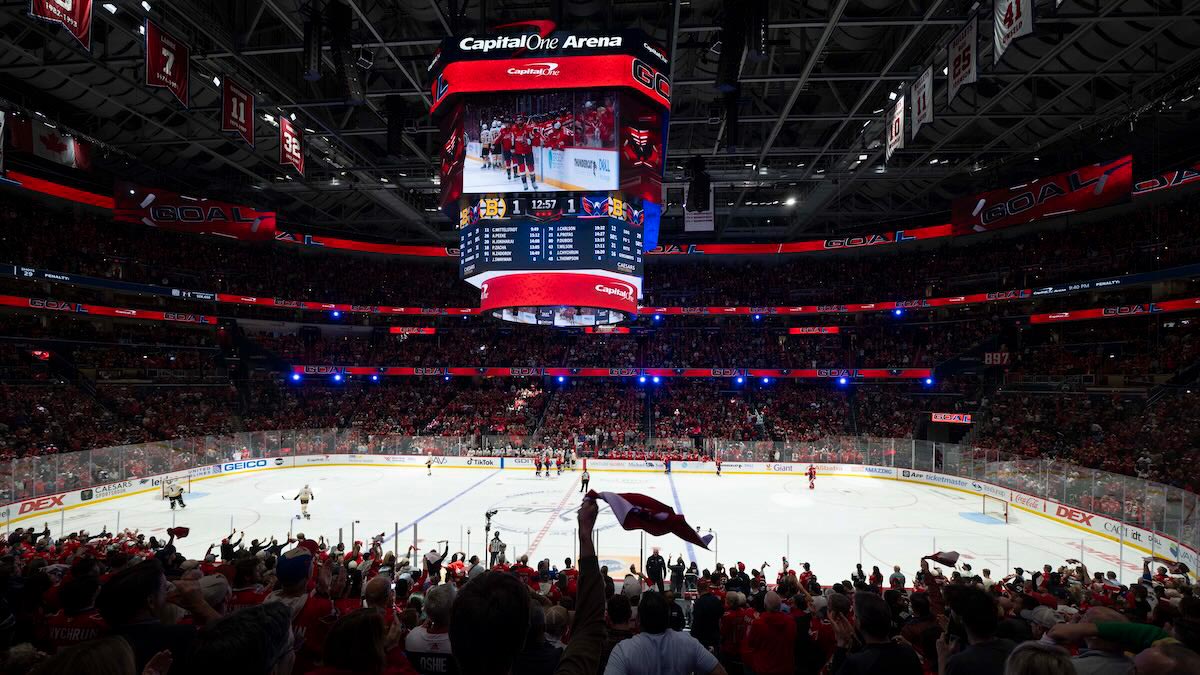



When 20,000 rabid hockey fans spilled into Capital One Arena in downtown Washington D.C. Tuesday night, the last thing on their minds was the network.
Yet they all enjoyed the benefits.
Because Capital One Arena, which hosts the Capitals (NHL), Wizards (NBA), and Georgetown University’s men’s basketball (NCAA), along with major concerts and other shows, has a network so fast, secure, and seamless that from a fans’ perspective everything just works. And whether ticketing, concessions, physical security, digital signage, or Wi-Fi 7 for ultra-swift uploads (when the on-ice action simply must be shared), it all adds up to a superior experience — for fans, players, and workers alike.
To get there, Capital One Arena’s parent company, Monumental Sports & Entertainment (MSE), implemented a sweeping $1 billion transformation— and on the technology side, chose Cisco as its trusted partner.
“The Capital One Arena Transformation Project is in the second year of a three-year effort to completely transform this nearly 30-year-old facility,” said Charlie Myers, chief technology officer of Monumental Sports & Entertainment. “We asked, ‘how can we completely reimagine our tech stack to drive fan experience?’ And we knew a partner like Cisco would help us build that infrastructure and enable us to keep transforming constantly.”
Before Tuesday’s game, Myers led a pre-game media tour through the winding corridors of the Capital One Arena. And he took the group through everything from The Cisco Command Center and clangorous data centers to immaculately renovated fan lounges and the unforgettable sight of adrenaline-fueled Capitals players warming up off ice with a soccer ball (pretty common in hockey, who knew?).
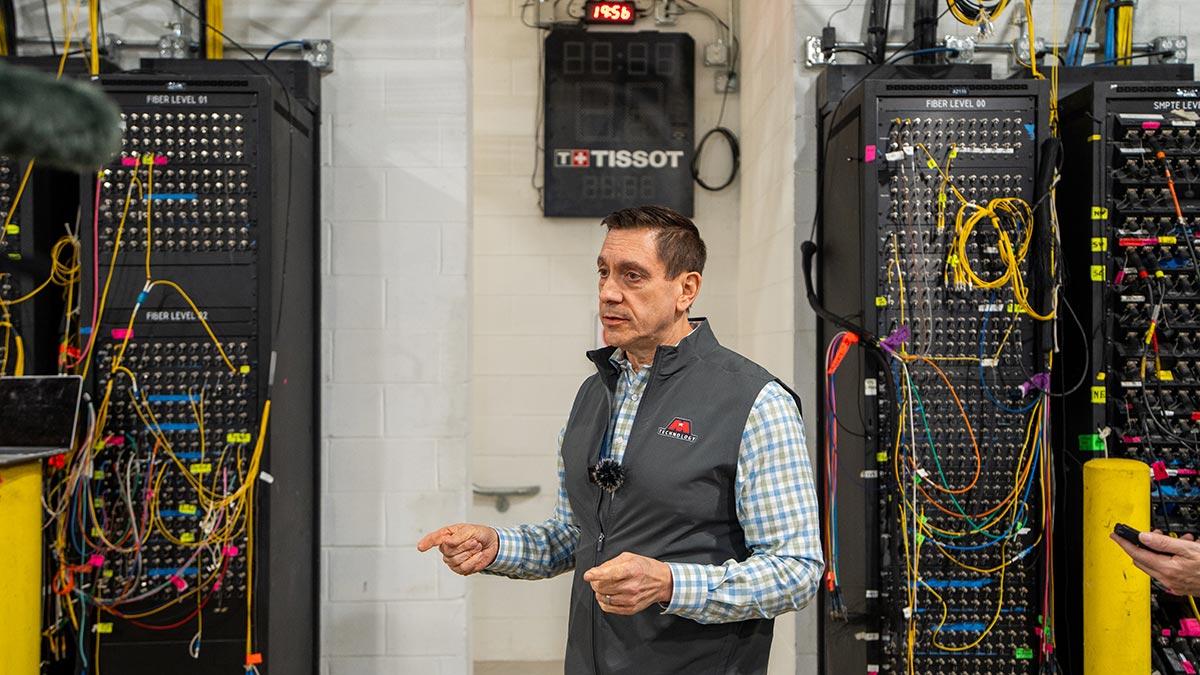
Monumental Sports & Entertainment CTO Charlie Myers discusses the Capital One Arena technology infrastructure.
A core theme throughout the tour? The close partnership between Cisco and MSE, which moves beyond a typical customer/vendor relationship into true co-innovation.
“You’ve got to find the right partners to rebuild from scratch,” said Zach Leonsis, president and vice chairman of Monumental Sports & Entertainment. “We only have one shot to get this right, and we needed a trusted partner who can handle scale, who's got great credibility in the space, has all the products, tools, and services to match our needs. Cisco checked all the boxes.”
Rick Sacchetti, Cisco’s area vice president for U.S. commercial east, added his own thoughts on how Cisco’s unique value prop was a factor from the start.
“Monumental’s vision to build a true technology platform to improve the fan experience, to leverage data, to improve operations, is what drew us together,” Sacchetti recalled. “And from our first meeting, it became clear to both of us that Cisco could help them deliver on this ambition. Because only Cisco could bring together the network with security, observability, and collaboration. They wanted one vendor to help pull it all together.”
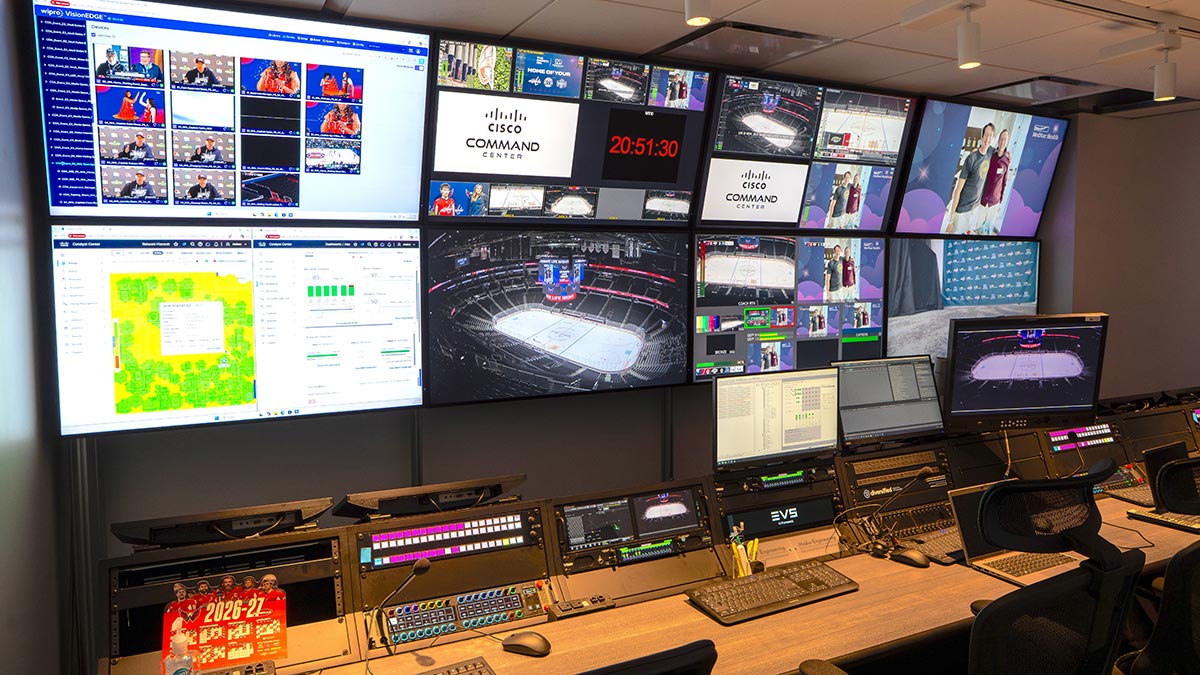
Inside Capital One Arena’s Cisco Command Center, operators monitor arena technology and venue operations.
The platform in action: The Cisco Command Center
To show first-hand how Cisco pulls it all together, Myers led the tour to the Cisco Command Center, including a Program Control Room and Network Operations Center. Each appeared highly complex, with arrays of screens. Yet Myers demonstrated the simplicity in monitoring a wide range of real-time activities, technologies, and potential issues. All due to a platform approach integrating products like Cisco Catalyst Center, Cisco ThousandEyes, Cisco Spaces, and VisionEDGE, from Cisco partner Wipro.
“We had nearly 30 years of stovepipe solutions,” Myers explained. “But we had an opportunity to envision an entire platform — to go from managing a lot of disparate technologies to a singular view, to understand the relationships in how they interact. And how that can impact game operations and fan experience.”
As media people crowded into the command center, Myers pointed out just a few of those monitoring and response capabilities.
“This is Catalyst Center from Cisco,” Myers explained, “which is where we monitor what's happening on the network, what's happening on Wi-Fi. You see there's a footprint that shows some of the wireless antennas, what's their coverage? And we look at how many devices are on there. Are we having throughput issues? Up above you'll see Wipro VisionEDGE, also through our Cisco relationship. Almost all the signage in the arena is being driven through that platform, and everything’s monitored here. It’s the nerve center of the whole operation. So, if there’s an issue, we’ll know how and where to respond.”
Simplicity extended to the somewhat cramped and cacophonous yet environmentally controlled data center, which has been consolidated and, in many cases, virtualized with software-based servers.
“Everything's about velocity,” Myers stressed, “how quickly we can react to business needs. And building a modern, flexible platform, including virtualization, gives us the ability to move really quickly. We've got a platform, particularly with Cisco UCS X, that gives us a lot of compute capabilities. And things that used to take months of planning and deployments can be spun up on a virtual machine. We do it on a daily basis.”
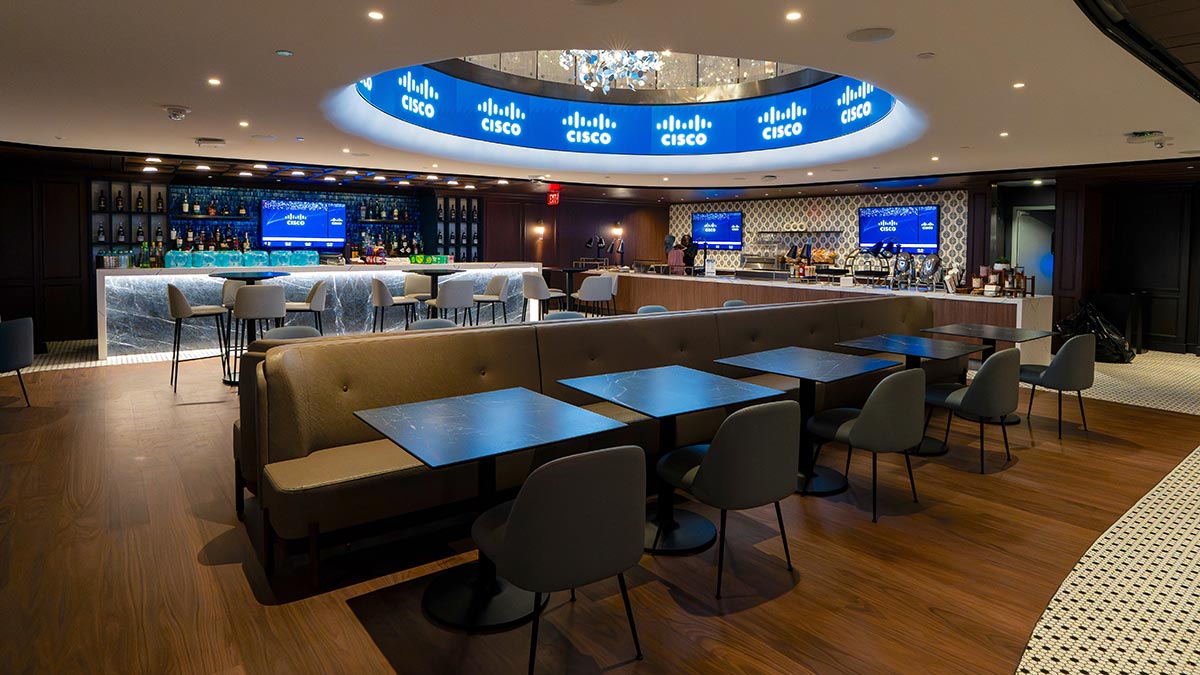
The United Lounge at Capital One Arena features Cisco IPTV and Wipro VisionEDGE across its digital screens.
A secure network built for future challenges — and great experiences
As Sacchetti called out, Cisco ThousandEyes is another critical element, providing expansive visibility all across the network.
“ThousandEyes helps them see deeply into the network in terms of what's happening traffic wise, what's happening out on the internet, allowing them to spot problems before they are reported,” he said. “That ability is going to be critical to delivering that fan experience. ThousandEyes allows them to do that.”
Myers considers fan experience to be MSE’s “north star.” And he proudly pointed out that Capital One Arena is among the first of its kind to deploy Wi-Fi 7. And he and his team constantly explore how solutions like Cisco Spaces can be used in new ways.
“Cisco Spaces is a platform that helps us understand traffic flow and people density,” he said. “That helps us within arena operations and seeing where people are going, what they are doing during events. We look at that then historically to understand things like managing congestion, where to deploy police. Even if someone’s looking for a bathroom, we can direct them one that is less crowded. So, we’re using it to, again, support that great fan experience.”
Of course, security is a big part of the fan experience. So, having security purpose built into every layer of the network was another selling point.
“We have over 500 venues across the world that are using Cisco to power the fan experience, to power the network and to protect and secure the environment,” Sacchetti said. “Live sports are natural targets. And Cisco, with our secure networking products, it's built in. We're able to help our customers operate with confidence.”
“It’s the same scalable, secure, low-latency network that powers the McLaren MasterCard Formula 1 team to shave milliseconds off of a high-speed race,” added Anne Ristau, Cisco’s head of global sponsorships. “It’s used here to make sure that the millions of fans who visit Capital One Arena get a frictionless experience in everything they do.”
However that frictionless fan experience evolves, Capital One Arena will be ready for years to come.
“AI already helps us get to an outcome much quicker,” Myers said. “We use it quite a bit, but over the next few years you'll see it become more deeply embedded. The key piece is that we built the foundation, the infrastructure, we got that right first. We have the right network and the layers of compute from Cisco. And we're ready to further leverage that for AI.”
As Leonsis agreed, this is just the beginning of what’s possible.
“We believe we are building one of the premier sports and entertainment venues in the entire country, if not the world,” he concluded. “So, we’re really excited.”
When the tour ended, thousands of fans streamed into the arena. And as the Capitals took the ice against the Los Angeles Kings, uploading smart phones were everywhere, digital signage, lights, and sound dazzled, and the excitement quickly reached a peak.
The invisible, off-ice MVP enabling it all? The network.