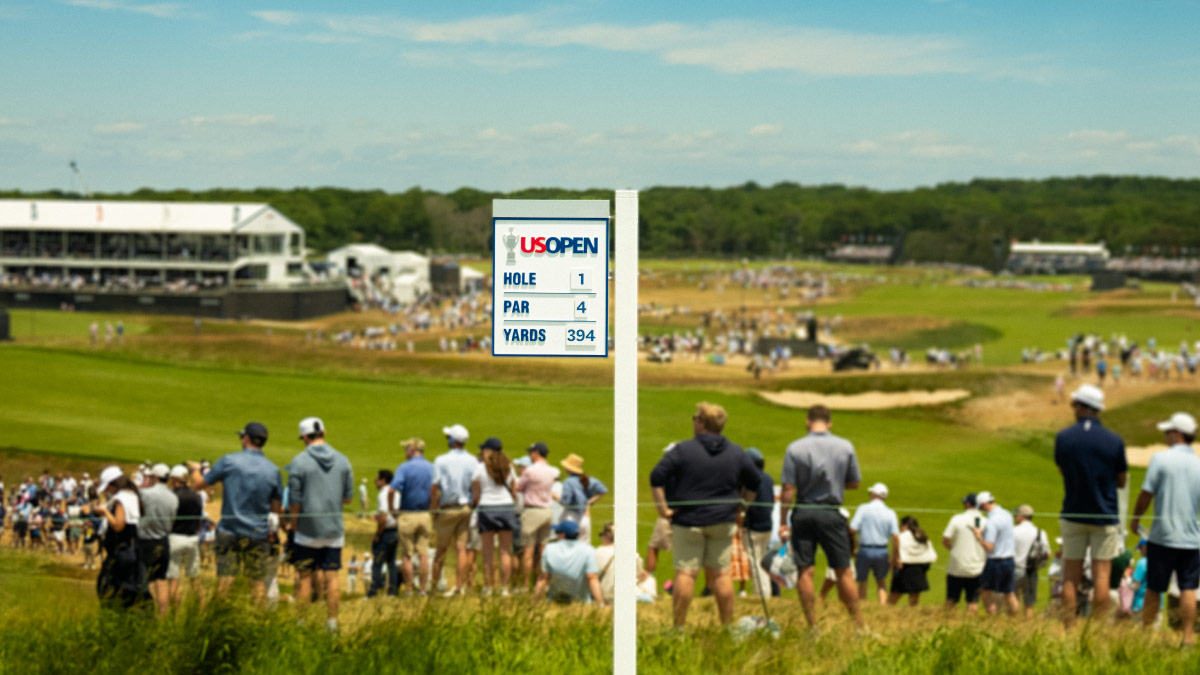



On a drab, wind-swept day in Shinnecock, N.Y., last month, thousands of supercharged fans gathered to see the likes of Viktor Hovland, Maverick McNealy, Cameron Young defy the weather and electrify the 126th U.S. Open Championship.
But golf’s biggest stars weren’t the only peak performers at the sport’s premier event. A Cisco/Meraki network — including Wi-Fi 7 and Cisco’s full-stack, platform advantage — ensured that the USGA’s dedicated IT team could support a massive event with seamless, secure fan interactions, physical security, ticketing, merchandise, digital signage, and more.
Speaking from one of the USGA’s mobile command centers — which included Cisco switches, Cisco Firepower, and Power over Ethernet, as well as Splunk analytics and observability — Christian Rodriquez, the USGA’s senior manager of IT operations, explained the importance of the Cisco partnership.
“Cisco’s all about the resilience, the redundancy,” he stressed. “The way Cisco builds their access points, the way they build in redundancy before we even configure anything is just phenomenal. These solutions are out in the field. You see the weather conditions they're in. And we never have environmental-related issues. From the hardware to the technology to all the configurations. Honestly, why would we not use it?”
Cutting through the complexity
In a highly complex operation with nearly 600 Wi-Fi 7 access points, 120 Meraki security cameras, and potential security threats, simplicity is essential. So, Anthony Santora, managing director of IT for the USGA, showed off the Cisco Command Center, where a Splunk-powered dashboard provides a single-pane-of-glass, unified view of the entire network footprint. This allows the USGA team to see everything happening across the course in real-time, pulling critical insights from massive waves of telemetry, enabling real-time responses to any issue.
Feeds from Meraki security cameras, for example, are shared with state and local police, as well as USGA operations teams seeking insight into fan behavior.
“In terms of the cameras, we deploy them everywhere,” Santora said. “The operations teams use them to monitor things like how much traffic is out there on the highway, how long does it take for people to get off the buses? Are there too long of lines at concessions? And they're making real-time decisions as a result of what they're observing."
A temporary network with the power of a stadium data center
Unlike a major sports arena, the U.S. Open does not rely on a permanent network. It must be set up and be configured quickly, then work flawlessly for an event that draws tens of thousands of fans across hundreds of acres.
“One of the biggest challenges for us here is providing that connectivity for fans that move throughout the course,” said Rob Neumann, Cisco’s director of sponsorship technology. “And with our latest Wi-Fi 7 products, we’re able to achieve that.”
Not to mention, spectators, influencers, and media share content at unprecedented rates. Especially considering the high-density “Tiger effect”: When crowds surround a major player in one spot at a crucial moment, the network must be ready for the surge in traffic.
“There are more people now uploading content than there are downloading content at golf events,” Neumann continued, while waiting to cross a fairway. “A lot of that is the content creation folks because all these influencers and everyone else are basically wanting to publish their content on site.”
Wi-Fi 7 is meeting those challenges with bandwidth to spare and a 5x increase in speed. That led Santora to play off the old joke that IT teams only hear from users when things go wrong.
“I’m getting calls like: ‘What's going on with the Wi-Fi here? It’s blazing, it’s amazing,’ ” he shared. “I said, ‘Oh my gosh, this is the first time I ever got called for a positive reason.’ ”
AI meets the full-stack advantage
When a small network and security team is tasked with a large challenge like the U.S. Open, integrated solutions are essential, as Zeus Kerravala, founder and principal analyst at ZK Research, expressed.
“When you look at the challenges of deploying a network at the U.S. Open,” Kerravala said while attending the event, “you need to approach it with a full-stack solution. And that's one of the things that makes Cisco unique. The combination of network and security, compute, observability with Splunk. You're not going to find that with another partner.”
Bob Laliberte, principal analyst at theCUBE Research, added his own thoughts on Cisco’s role supporting the USGA operations team.
“The transition to Wi-Fi 7, in particular, is a huge game changer for them,” he said. “And the ability to have all the pieces integrated, between the security side, the wired side, the wireless side, and observability, so they can look at what's happening and be able to make changes quickly, that’s huge. They had to set up and support this environment in basically two weeks. And there are 40,000 to 50,000 people coming, and they're not sitting in the same space. They’ve been telling us today that Cisco gives them that ability to support this in a very dynamic manner and adjust as needed.”
AI, of course, has become a huge factor, both in how the USGA team manages its networks and security and in how the organization interacts with fans.
Recently, the USGA launched Rules AI, an intelligent assistant designed to instantly answer golf-related questions in plain language. Trained on over 25,000 verified rules queries, the tool provides authoritative, accurate rulings on the course and is integrated directly into the official mobile application.
Cisco AI Defense is a critical layer in keeping the tool secure.
“AI Defense is our first — and last — line of defense,” Santora said.
Santora’s also embracing how Cisco’s agentic AI can further empower his team.
“We’re super excited to be leveraging AI to tune the network and find problems or optimize things,” Santora continued. “And we’re looking to do more. Agentic tooling like this can give us expert level recommendations that we might not otherwise have.”
Of course, Cisco is constantly expanding its agentic AI dimension, infusing it into products like Cisco Spaces, Cisco IQ, AI Canvas, and the groundbreaking, recently announced Cisco Cloud Control.
Ed Green, Cisco’s portfolio CTO, stressed the great relationship that Cisco has with the USGA — citing its innovative approach and quickness to adopt such new technologies and products.
“Seeing the USGA continue to adopt our products, and in the case of AI Defense to secure their rules app,” he said, “is a test of true partnership. As we've been speaking to them throughout the day, they’ve stressed the resiliency, the ease of use, the full-stack solution. And they just keep innovating. I'm excited to see them use Cisco Cloud Control next year to make the operations even more simplified. All in all, they're a great partner.”