


Art and technology can seem like separate entities.
But when they align, amazing things happen.
“I'm sitting in Italy,” said Gianpaolo Barozzi, Cisco’s VP and chief technology officer for people, policy & purpose. “If you go back to the Renaissance, with great geniuses like Leonardo da Vinci, that was a major innovation period in which science and art were strongly connected.”
To express that connection in a 21st Century context, Barozzi came up with a novel idea: to bring together top artists and engineers to showcase how inventive, imaginative humans can co-create with one another — and with AI as a critical teammate and collaborator.
“In a world where utopians believe AI will take us to heaven and dystopians fear it will cause the end of humanity, I was trying to find a new way of looking at it,” he said, “particularly how AI and humans can not only coexist but work together and create together.”
When Barozzi met the artist/scenographer Paolo Fantin, the idea began to take shape.
“We started from human emotion,” Fantin said. “The technology was there to make that connection, to translate those human emotions, those memories, into visual and musical poetry.”
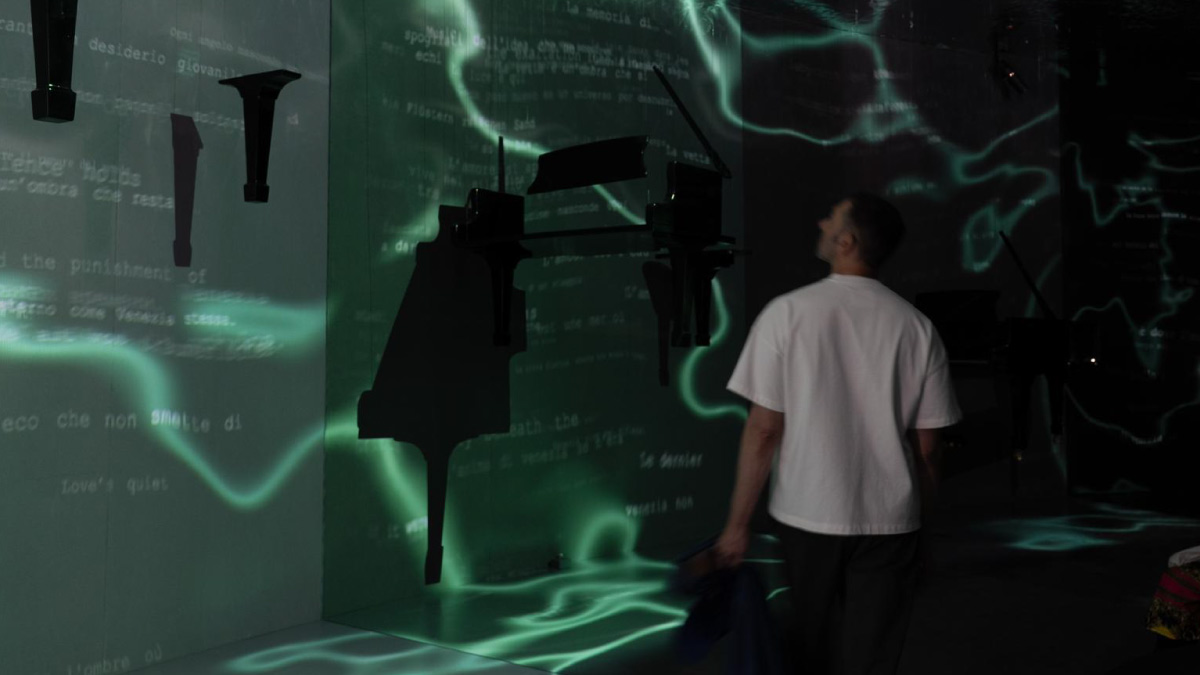
The result is Echo, an immersive, interactive experience at the Venice Biennale that transforms impressions of the city — shared spontaneously by viewers — into AI-generated light, music, and motion.
For visitors, it’s a wondrous, streaming archive of Venetian “echoes,” expressing everything from the poetically profound to the beautifully mundane. All as they walk a 15-meter tunnel through the waters of the Venice Lagoon.
“It’s the echo of history,” Barozzi reflected, “it’s the echo of the feelings of the people that experience Venice.”
Agentic AI as creative partner
Echo demanded high-intensity co-innovation between Fantin, Barozzi, musical composer Dardust, a Cisco team of engineers and designers, and Cisco’s partners H-Farm/Shado and Logotel.
AI played as much a role in the creative process as in the final experience.
“Our Cisco designers poured their energy and passion into this project,” Barozzi explained. “Thanks to our Webex platform, we shared feelings, feedback, and perspectives across dozens of meetings. And AI enabled us to ideate all kinds of ideas virtually and quickly, so that when we built a prototype, it was exactly what we wanted.”
As for the human connection, artists and engineers quickly discovered they had much in common.
“It was amazing working with Paolo,” said Jan Brabec, principal AI researcher at Cisco. “He is an artist, but he is also great at pragmatic problem solving. That is necessary when taking the vision from abstract to concrete.”
From the artistic side, Fantin praised the synergy that quickly emerged.
“At first I thought it would be difficult to explain to the engineers how to express a human emotion,” he recounted. “But it was the complete opposite. The guys we worked with knew right away how to transform emotions into something creative, something that wasn’t just a number.”
Of course, the unique mix of artists and engineers was completed by AI, which acted as a force multiplier, without diminishing the human touch and creativity. Each played a crucial role in creating the final experience.
“The result could not have been achieved by developers only and could not have been achieved by artist only,” said Barozzi. “And it couldn't have been achieved by AI only.”
Stretching the boundaries of AI
Not that it was easy. All agreed that the project stretched the limits of how AI and humans can interact. For example, when responding to abstract, emotional concepts, AI needed more detailed prompts.
“A lot of the current focus and efficiency of AI tools is in things like engineering, administrative work, and even some design,” explained Nick Zolfo, a Cisco product designer. “When you ask AI to create an artistic representation of an abstract idea, you are pushing the boundaries of how we work with AI agents.”
Virtual prototypes took the creative process as close to the real experience as possible, as Edgar Uribe, a Cisco senior software engineer for enterprise AI and search, explained.
“I needed to not just help create a platform for the artist to see his vision,” he said, “it needed to be one where he could feel his vision.”
That meant approaching the scale of the project with digital twins that filled rooms, not just screens, using multiple projectors and a full sound system.
“It was that element of needing to feel what we were developing,” Uribe added, “with not just a technical interpretation, but an emotional interpretation.”
Art, Cisco, and the positive potential of AI
Cisco is a leader in AI innovation and promotes responsible uses of the technology. It uses AI across its entire product portfolio, streamlining efficiency and user experiences in networking, security, observability, and more. And the company’s Responsible AI Framework and principles have set the highest standards for the industry.
So, Barozzi views Echo as an opportunity to showcase not only Cisco’s innovation and technology but its commitment to the positive applications of this groundbreaking technology. All while reinforcing that notion that all great technology needs an artistic and empathetic element — to ensure that it’s powerful, elegant, and simple to use.
“We are a technology company that is investigating the forefront of the relationship between AI and human beings,” Barozzi expressed. “And we want to use AI in the best possible way for humans. So, it’s important for us to engage with artists, since creativity is a unique and exquisitely human characteristic.”
For Fantin, the exhibition is nothing less than a way to support connections, compassion, and understanding in a challenging world.
“The world can feel like a dark place, where no one listens and everything moves too fast,” Fantin expressed. “And AI can seem scary. But I don’t see it that way. Because there’s something touching about people sharing their personal thoughts and problems. This is a way for people to share their inner thoughts and be connected.”
“And as you go deeper under the water,” he concluded, “the experience lets you go deeper into yourself. Then you can share it, and through the technology the emotions find connection. It’s very powerful.”