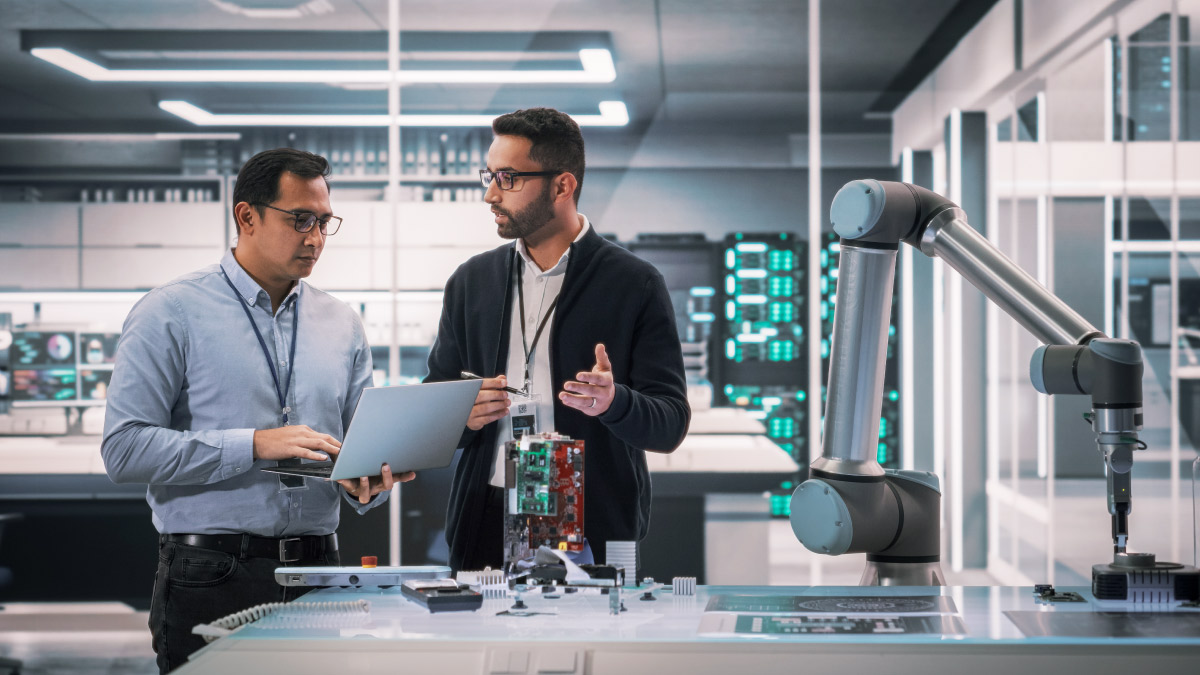



In complex, rugged environments like manufacturing floors, container-ship ports, or power utilities, AI has an essential role to play.
But Cisco’s 2026 State of Industrial AI Report reveals that while 61 percent of industrial users are actively deploying physical AI, only 20 percent have successfully scaled the technology.
The study, which surveyed 1,000 industrial professionals across 19 countries and 21 sectors, delved into what’s holding many organizations back — and what the mature “pacesetters” are doing right.
For further insight, we turned to Vikas Butaney, Cisco’s SVP and general manager of secure routing and industrial IoT. Along with the great promise of physical AI in the industrial space, he shared his thoughts on everything from infrastructure and security to wireless connectivity and bridging IT/OT silos.
Great to have you with us today, Vikas! Let’s start with a quick introduction to industrial networking. What types of environments are we referring to?
Hi, Kevin! Most people think of Cisco in campus and branch settings, but our customers’ footprint is much broader. They need ruggedized or industrial networking capabilities to manage their retail distribution centers, factories, utility substations, container terminals, traffic signals, and more. These environments are at the heart of their businesses, so resilient, secure connectivity is mission critical.
What kinds of advantages does AI promise in the industrial space?
For decades, our customers have sought automation that improves employee safety and drives operational efficiency. Take one of our large U.S. automotive customers: their body shop is already fully automated. AI is now pushing into the next frontier - final assembly. That is where physical AI, and Cisco, have an important role to play.
What are some specific examples of what AI could do?
Let me start with two. First, machine-vision systems. Today, sophisticated cameras monitor everything about a customer’s environment. The large automotive company to which I referred has high-fidelity cameras that can detect the smallest scratches or blemishes — dramatically improving quality inspection. Second, material-handling systems. Automated mobile robots, or AMRs, can navigate a factory floor and deliver material to the installer so that he or she can keep working without interruption. These are just two use cases where AI is making a real difference.
Many organizations want those kinds of benefits. But in Cisco’s latest Industrial AI Report, only 20 percent have successfully scaled. What are some key impediments?
Two stand out. First, identifying the right problem where AI can deliver clear ROI. Second, ensuring that the network in these environments is ready. Most manufacturing settings still run hundred-megabit per second ethernet, yet a single machine-vision camera can demand one-to-ten gigabits per second. Our report confirms that AI workloads demand more edge compute, more bandwidth, and greater reliability than legacy designs can provide. So, the question becomes: Is your infrastructure ready?
Let me guess, the third key impediment is security.
Exactly. Before realizing the benefits of AI, you have to ask: Is my process data being exposed through a public LLM or public web service? How deep is cybersecurity integrated into my operations? The report found that 40% of respondents cite cybersecurity concerns as a top obstacle to AI adoption. So, building security into the network foundation allows organizations to deploy AI at scale without constant fear of operational risk.
Successful adopters in the Cisco study have cracked the IT/OT collaboration challenge. What benefits do those organizations unlock?
IT teams have a vital role in helping operations teams be successful and secure. OT teams understand the process, the domain, and the environment. When these two teams partner, they unlock the gains that AI can bring. And that collaborative environment is a key ingredient to unlock value, as our State of Industrial AI Report confirms.
Is it technology or culture that is holding some of them back?
It's not just about the technology. Currently, 43% of organizations still operate with limited or no IT/OT collaboration. The question is: Have our customers recognized the synergy in working together, and can they collaborate effectively to unlock the value?
Cisco covers pretty much all these bases, infrastructure, security, collaboration, AI, wireless connectivity, and more. That alone is a differentiator. But what else is unique in Cisco’s ability to help customers scale industrial IoT?
Cisco’s been actively engaged in the industrial domain for the last 20 years. Through partnerships like Rockwell Automation, we’ve learned industrial automation at a deep level. And we’ve always been an open, ecosystem-oriented company — working closely with automation teams and machine builders. In short, we bring deep, secure networking expertise that we are extending into operational settings, with cybersecurity built directly into the network, to help our customers succeed.
All of that is integrated with Cisco’s platform advantage.
Yes, and that platform is a key differentiator. With workforce shortages, IT and the OT teams need to work together. So, from a platform point of view, we have taken Catalyst Center and Catalyst SD-WAN Manager, which are traditionally used in campus and branch settings, and extended them into operational environments. Next, we’re connecting our industrial portfolio to the Meraki Dashboard. So, our users have a common platform that integrates purpose-built products across their entire environment.
What is next? How can Cisco help more organizations reach that mature, “pacesetter” status in industrial AI?
Cisco will continue to provide the high-performance, reliable networks that AI workloads demand — with a security-first design that gives customers a strong foundation for innovation. A great example of this is wireless — it’s becoming the predominant way that industrial machines get connected, especially in the AMR space. Cisco is the market leader in Wi-Fi, and I’m excited about how we're integrating our Ultra-Reliable Wireless Backhaul technology with the broader Cisco Wi-Fi portfolio. All of this together places Cisco in a unique position to enable these AI use cases, from machine-vision to AMRs. I'm super excited about how we are solving these top-of-mind customer problems and helping them be successful for many years to come.
Case studies:
ZEISS: https://www.cisco.com/site/us/en/about/case-studies-customer-stories/carl-zeiss.html
Planet Farms: https://www.cisco.com/site/us/en/about/case-studies-customer-stories/planet-farms.html
E80: https://video.cisco.com/detail/videos/success-stories/video/6390637065112?autoStart=true