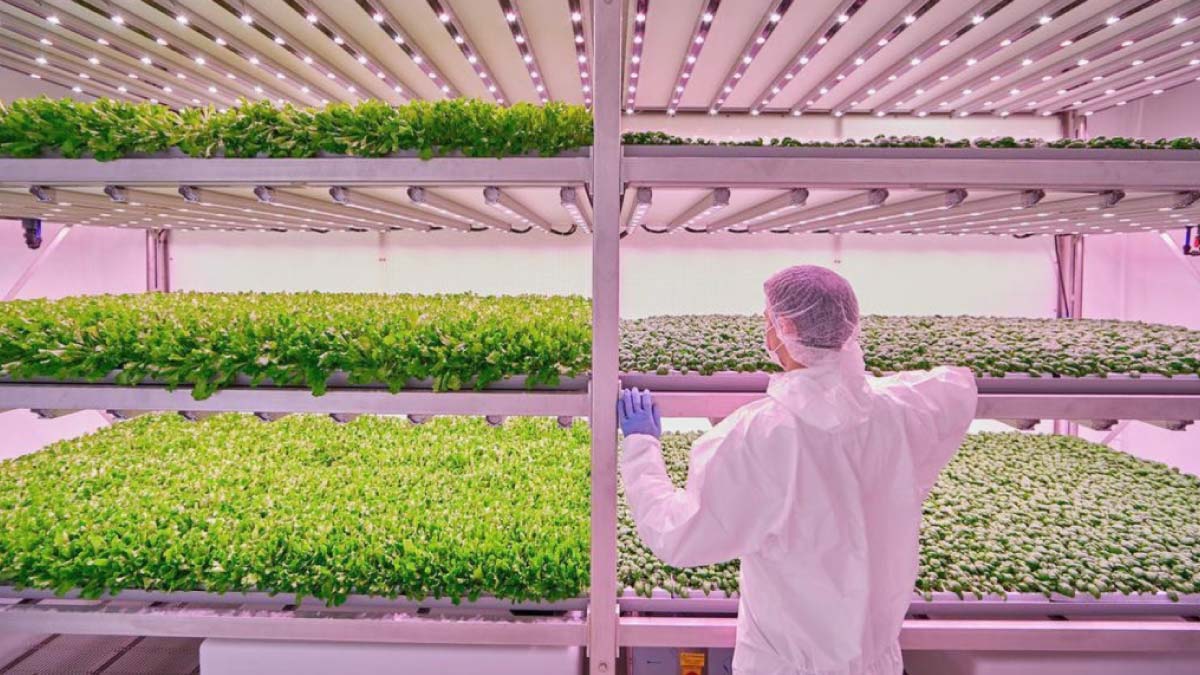



Lettuce and AI infrastructure might not seem to go together.
But Planet Farms — and its partner Cisco — are proving otherwise.
With its AI-powered, vertical-farming concept, Milan-based Planet Farms is pioneering an alternate approach to agriculture — one that meets the challenges of a changing climate, soil depletion, food access, and rapid urbanization, to name but a few.
Technology is at the heart of it, with AI managing everything from lighting and indoor atmosphere to robots and 3D cameras. Not to mention, Planet Farms uses precise amounts of mineral-rich water, then recycles it. That lessens water needs by 96%, compared to traditional farms — important at a time when agriculture accounts for 70% of groundwater usage, globally.
Given all that, Cisco — which provides the critical infrastructure and security for the AI era — was a natural partner.
To learn more, we spoke with Massimo Mistretta, Planet Farms’ chief information security officer. He shared his thoughts on next-level agricultural efficiency, the company’s deep reliance on Cisco technologies, and its future potential beyond Italy and green, leafy vegetables.
Thank you, Massimo, we’re excited to learn more about Planet Farms! Let’s start with the initial spark that led to Planet Farms’ founding in 2018 and your overall mission.
Thank you, Kevin! Our mission is to produce food in a very sustainable way, but with Italian quality, food that is nutritious and flavorful. Planet Farms challenges a widespread assumption, which is that agriculture relies on land, climate, and seasonality. And the real spark was treating food production like a digital system — to start thinking about an engineering process that would allow us to create food without the consumption of land, without the consumption of water, one that was completely against the use of natural resources.
As your website states, your process uses less water, zero pesticides, no soil, and can be located close to the people who consume the food — in an urban environment, for example.
Yes, it’s a demand-driven agriculture. That is, grow what you need, when you need it, and where you need it. Planet Farms is getting closer to the people that consume the food — today it’s focused on salad, but this could apply to other kinds of crops, like cotton or coffee.
You’ve said vertical farming demands a sweeping "change of perspective.”
Well, we grew up thinking of agriculture as something that scales in a horizontal way. If you need to grow more, you add more land, and there is a horizontal expansion. With vertical farms, you grow upwards in layers, in a controlled environment, where the lights, the climate, the water, is fully controlled by the system. This leads to tremendous resource efficiency. And our “clean rooms” have a very low-level of airborne particles. This is a pharma-grade way of producing food.
You’ve also described the vertical farm as an "organism" or a "network.” How so?
Well, we think of our production areas as living organisms. But we also think of them as a cyber-physical integration. We have thousands of sensors, we have robotic systems, harvesters that automatically do their jobs, and vision systems that are fully automated and powered by machine learning that analyze the data in order to take actions. Everything's automated through intelligent process automation — and agentic AI. So, the network becomes very important because it allows us to orchestrate the information across the entire corporation. We see it as the nervous system able to deliver the signal where it's needed and when it's needed in a timely manner, which is fundamental for our operations.
What Cisco technologies and services do you use?
We work very closely with Cisco’s Industrial IoT Solutions business unit, but we also use Cisco for all the other corporate activities. So, we rely on Cisco’s networking and 6 GHz Wi-Fi as well as its industrial wireless, the Ultra Reliable Wireless Backhaul [URWB] system to connect all these sensors, systems, and other devices. And that has been a leap forward for us.
Before you started working with Cisco, you encountered issues with roaming robots and latency. How did Cisco resolve these challenges?
So, like many in the industry, we suffered around connection of the robots and latencies. But with the Cisco system, that disappeared completely, which is an enormous advantage for what we do and at the speed at which we do it. The main reason why Cisco’s URWB is different from all the others is that it keeps a concurrent connection with multiple access points. So, it never loses the connection. And roaming is made seamless. This is also the reason why the other systems that we have tried before have failed.
Cisco fuses security into its networking equipment. How important is that?
As the person in charge of cybersecurity, it’s very important to me that Cisco security is embedded at the network level. All the other security layers that we have been putting on top are, let's say, nice to have. But when we look at this entire stack that we have built with Cisco, we just feel much more secure with this infrastructure.
Planet Farms uses agentic AI in innovative ways. How has that changed the operation?
The world of agentic AI, the world of LLMs, brought the ability to have conversations with machines. This means that language is the key difference that we see today that we didn't have in 2018. Back when we started, and as soon as I joined the company, we immediately started to deploy automated robots. After one year, we had hundreds of those robots. What we see differently today is that those robots have the capability of having a conversation which is meaningful. And the ability of these systems to make decisions in a more autonomous way has increased quite a lot.
All that data can put a lot of pressure on a network that’s not ready for it.
Yes, as one example, we have 3D cameras running throughout the entire production area on a daily basis, and those images need to be transferred and analyzed. And the information needs to be immediately delivered to the point where it is needed. So, we're talking about terabytes of data that is produced on a daily basis. And that's where a reliable network, which is also high bandwidth, is needed.
You’ve said the Cisco network gives you the ability to scale. What’s next for Planet Farms?
Yes, and I would like to give a special praise and a thank you to the Cisco Industrial IoT group. They have really helped us solve some our most burning problems. And today we have plans of expanding throughout Europe. There have already been announcements regarding the UK and most likely the Nordics fairly soon. Also, we’re aiming for other crops. Cotton, coffee, and other crops have large potential in terms of market. But there’s also social implications in their supply chains. Our ability to grow food in a closed environment and close to the consumption might impact those issues in a positive way.
And no matter where you are, or what problems you’re trying to solve, the food’s going to taste great.
Yes. I mean, we’re Italians; it has to be that way!