


Growing up in Brazil’s Amazon region, João Davi saw one future opportunity: fishing.
But while he was proud of his family’s four-generation tradition in the coastal town of Mocoóca, his hunger for knowledge led him in other directions.
Cisco Networking Academy made it possible.
“My father is a fisherman,” Davi said, “and he always told us he didn't want us to follow that path. That really stayed with me, because today I can see how tough it is.”
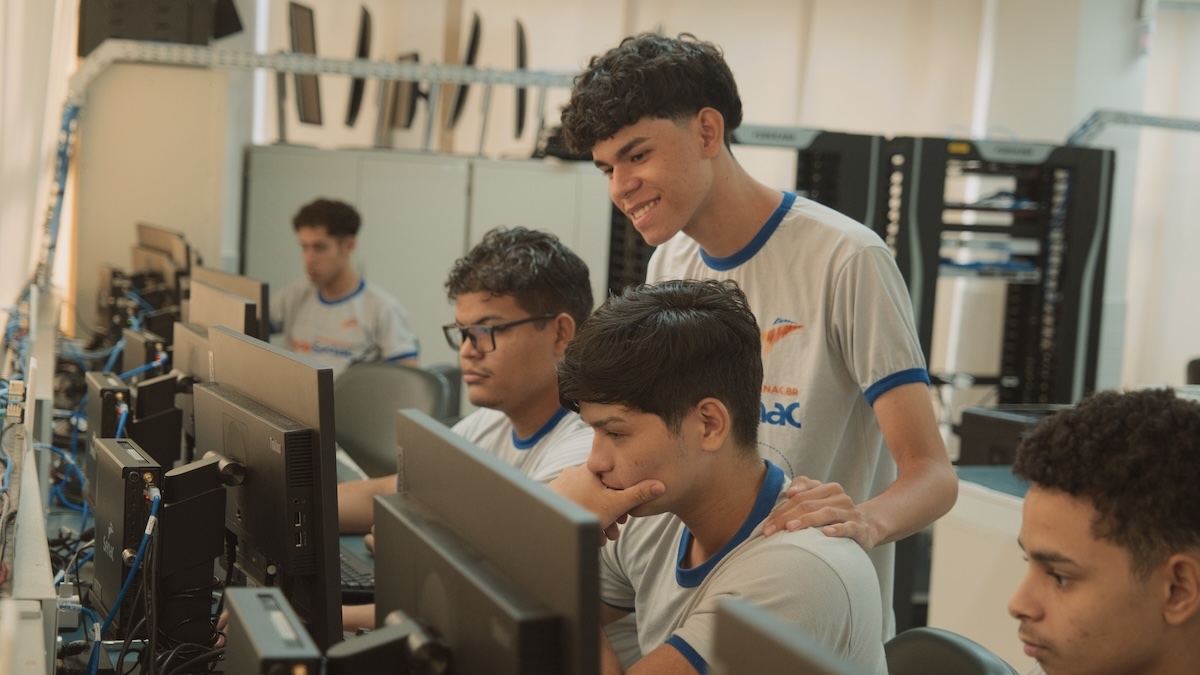
Today, Davi is taking free networking and security courses in the north-Amazon city of Belém, where SENAC, Brazil’s national commercial training service, continues a long partnership with the Cisco Networking Academy. And he’s dreaming big.
“Cisco Networking Academy has really changed my life and will keep changing it,” Davi shared. “It even helped me see the world differently. I want to go far, who knows, maybe even work with Cisco one day. That's a big dream of mine.”
Cisco Networking Academy is among the most impactful digital skills programs of its kind. Since 1999, it has empowered more than 28 million people in 191 countries, including more than one million in Brazil as of last year. A key focus is reaching students in underserved areas, which in Brazil can mean an impoverished urban favela or a remote Amazon riverside community.
It’s an initiative that sparks passionate commitment among all who are involved.
“We work out of love,” expressed Simone Amaral, who is one of Davi’s instructors in Belem. “Being able to actually make a change and make the students understand that they can do it, they can learn and pursue their goals, that's genuinely priceless. The SENAC and Cisco Networking Academy partnership is brilliant.”
Unlocking a vast, untapped resource in talent
With 4.8 million cybersecurity roles open globally, the need for skilled workers is critical. And the Amazon region is teeming with ambitious, emerging talent eager to learn and develop high-value tech skills.
“Bringing digital skills and connectivity to the Amazon is not only about inclusion,” said Ricardo Mucci, president of Cisco Brazil. “It's more about unlocking potential that exists in an incredible region with a very young population. But geographic insulation has historically limited access to quality education, professional opportunities, and connectivity.”
The SENAC/Cisco Networking Academy floating ferry school is one example of Amazon outreach. The boat plies the Amazon River, providing education, skills training, and local Wi-Fi to isolated riverfront communities.
One goal is reducing the need for committed students like Davi to travel to cities like Belém for their studies.
“Mobility is essential in the Amazon,” said José Roberto Tadros, president of SENAC. “Many communities are isolated and have no roads, which makes conventional education nearly impossible. That's why flexible models and trusted partnerships are so important for ensuring education can reach everyone.”
Dr. Guy Diedrich, Cisco’s senior vice president and chief innovation officer, also leads Cisco Networking Academy and the company’s Country Digital Acceleration (CDA) program, which supports the ferry school. He considers tackling the interrelated challenges of connectivity and skills to be among the most important in the world — and the Amazon region to be one of the most challenging but essential to transform.
“It's one of the most difficult areas we've ever taken on,” Diedrich stressed. “But it shows that we're willing to take on really hard things. Because if you don't, you're not powering a more inclusive future for all.”
Davi can attest to the hardships of poor connectivity. In Mocoóca, he had to travel many miles for internet access. But it was during one of those short sessions that he discovered Networking Academy.
“Studying in Mocoóca was a good experience,” Davi recounted, “but the education wasn't the best. I felt there was something more out there. There wasn't much internet. The connection was almost zero. We had to go to a specific place and pay to use it for an hour or two.”
New opportunities: for people and for the environment
As Mucci stressed, creating opportunities in the region is both an ethical imperative and a strategic economic move. It’s also essential for a critical ecosystem that faces grave pressure from practices like clear-cut logging, with implications for the entire planet.
“The challenge that we have right now is real,” Mucci said. “Connectivity, infrastructure gaps, and transportation barriers all limit access to qualified instructors. And at the end of the day, that leads to economic vulnerability. But pulling these challenges together creates a great opportunity. The Amazon can become an important technology-driven sustainability hub. We can use these digital skills to create new economic opportunities while supporting the environment. That's going to be a benefit, not just for the region, but for the world.”
One reason why Mucci is so passionate about CiscoNetworking Academy is because he himself grew up poor in a Sao Paulo neighborhood. But while education made all the difference in his life, he’s quick to add that inclusion isn’t just about education.
“It's economic inclusion as well,” he emphasized. “Talent is universal, but opportunity is not. So how do you close those gaps? World-class solutions like Cisco Networking Academy and CDA are important tools for that, together with our partnerships. And I’m very proud of what we are doing here with our Cisco Networking Academy and CDA team in Brazil.”
Of course, there’s always more to do. And Mucci is focused on reaching remote communities and encouraging more women to choose careers in tech.
Because as Diedrich has seen, Cisco Networking Academy “can literally change lives.”
“You can be in a job without much future,” he said, “take a networking course and get your Cisco Certified Network Associate [an entry-level certification] or your CCNP [a professional-level credential]. And in a matter of months and you're instantly employable."
In short, Diedrich concluded, “it’s a golden ticket.”