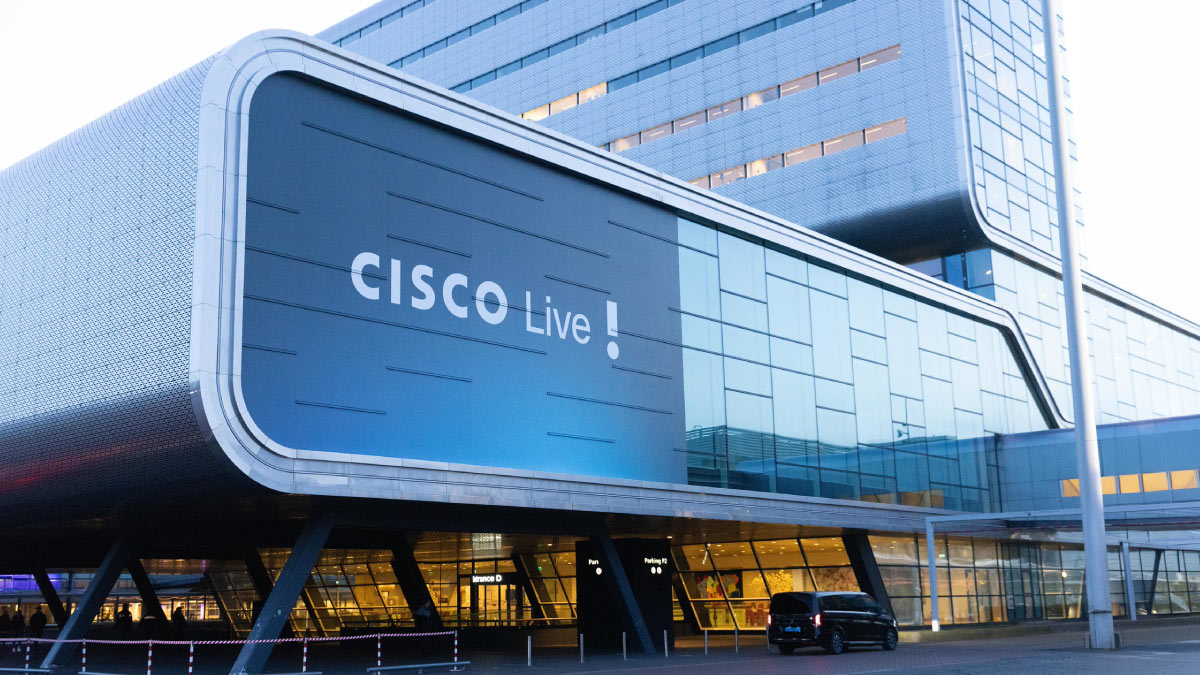



“This is a defining moment for all of us,” Cisco’s Gordon Thomson said of the seismic shift driven by artificial intelligence.
Speaking to 21,000 customers, partners, and tech analysts at Cisco Live EMEA in Amsterdam this week, Thomson insisted that Cisco is the one company best suited to help organizations capture this moment — and their share of a global AI opportunity that IDC estimates at $23.3 trillion by 2030.
“Together with our partners and combined with the pace of innovation we're delivering like never before,” said Thomson, who is president of Cisco’s Europe, Middle East and Africa region (EMEA). “There is an incredible opportunity for every single one of you here to build the infrastructure with the speed, with the security, and the scale that is necessary.”
“I'm confident that there's no one better than Cisco to deliver the outcomes you need in the future,” he added. And important announcements — including the Cisco Silicon One G300 switch silicon; advanced systems and optics; expanded AgenticOps capabilities; enhanced AI Defense; quantum-ready capabilities, and more — supported Thomson’s claim.
Enrique Uriel, CIO of Real Madrid, agreed. Real Madrid has been a Cisco customer since 2000, and last year extended its multi-year partnership. With the latest Cisco networking, Wi-Fi, and security, its 83,000-seat Santiago Bernabéu Stadium has been transformed into one of the safest, most connected large arenas in the world.
“We decided this is the only company that can deliver end-to-end a value chain that is seamless and providing robustness, reliability, scalability, and a present and a future,” Uriel said from the Cisco Live stage.
Bringing it all together
As Jeetu Patel, Cisco’s president and chief product officer underscored, Cisco is innovating at a breakneck pace and investing billions of dollars to solve three key impediments to AI value — around infrastructure, trust, and data.
“When it comes to addressing these challenges,” Patel said. “Cisco is at the center of it all. We are the critical infrastructure company for the AI era. We're going to make sure that we can provide you with high performance, low latency networking, that's energy efficient. We're going to provide you with compute. We're going to provide you with optics. We're going to provide you with security. We'll provide you with observability. We'll provide you with collaboration — the entire apparatus that's going to be essential for making sure that we can move forward.”
Cisco’s simplified platform strategy and sheer breadth of integrated solutions — including advanced AI analytics and observability from Splunk — are a big part of its innovative vision.
“Cisco is one of the few companies that makes our own silicon,” Patel explained, “makes our own systems, makes our own software, makes our own security platform, makes our own observability platform, has our own data platform — and it all works together in one cohesive unit. This is a massive differentiator.”
Patel then introduced the new Cisco Silicon One G300, a revolutionary 102.4 Tbps programmable switching chip. Purpose-built for the next generation of AI data centers, it will power the Nexus 9000, as well as Cisco 8000 series. And the G300 can handle gigawatt-scale clusters used for training, inference, and real-time agentic workloads.
“Our G300 chip is a hundred terabit switch,” Patel announced, “and it enables infield upgrades without silicon spins, which means it's fully programmable. Now, these advanced G300 chips are available both in air-cooled versions of systems as well as liquid-cooled versions of systems.”
The Silicon One G300 is just the latest innovation coming out of Cisco's unified silicon architecture. The P200, announced last fall, is designed to enable "scale across." That is, connect multiple data centers to form large, multi-data center clusters to meet the accelerating agentic AI demands. This requires an entirely new set of networking capabilities, like deep buffers, to make sure AI training workloads aren't disrupted. And just like the G300, Cisco is showcasing its ability to not just introduce innovative silicon, but pair with systems and optics to drive even more efficient performance.
“Last year we launched a new chip that goes into the 8223 router,” Patel said, “which is a scale-across chip. It's called the P200 chip. And this is a 51.2 terabit silicon that processes about 20 billion packets per second and consumes about 65% less power. But here's the beauty about the P200 chip. It has capabilities like deep buffering that allows you to have these very large packets moving from one data center to the other.”
No AI without Trust
Given the tremendous potential of AI, it's essential that users trust it. So, protecting privacy and security are imperative.
“We cannot have an AI-driven economy that we can't protect,” Thompson emphasized. “AI should start with safety and security.”
Patel continued with a deep dive into Cisco’s security strategy — platform-based, AI powered, and fused into the network.
“AI demands that security stays close to the workload,” he said. “We need to make sure that we can bring Cisco Secure Firewall together with the other cloud protection products. And that's what we call the Hybrid Mesh Firewall. So, we're able to take that physical and virtual firewall and tie it to Secure Workload. We can tie it to Hypershield. We can even push policy into third-party products that are not Cisco products from our management plane.”
It’s all about simplifying and extending security and trust to any point where it’s needed, from the branch to campus to data center, at the edge, and all the way to the cloud.
“This is the future of the networking infrastructure,” Patel observed. “We’re going to fuse security into the fabric of the network, where you can actually have security getting enforced on a top-rack switch. You can have security enforced on a server. You can have security enforced on an agent that's sitting right next to the kernel, but in user space.”
CX, networking, and security, empowered by agentic AI
Adele Trombetta, Cisco’s SVP and GM for customer experience EMEA, shared how agentic AI is transforming customer experience. Using an advanced agentic AI solution called Cisco IQ, customers can expect a personalized, intuitive, conversational interactions to solve a wide range of issues and questions.
“All Cisco services are now underpinned by Cisco IQ,” she said. “With Cisco IQ, we are embedding AI directly into your operation. And we don't just fix problems. We prevent them. And when they do happen, we fix them significantly faster and with less effort.”
Technology is just one part of the story, however.
“Equally important is our talent,” Trombetta continued. “Agentic AI combined with human expertise allows us to create a fantastic ecosystem, to work together alongside your team and with our partners.”
Patel shared some final thoughts on how agentic AI is transforming Cisco technologies, along with the company's simplified, integrated platform vision. In particular, he looked to an upcoming 2026 release, Cisco Cloud Control.
“We're going to have completely reimagined and simplified agentic ops for managing your entire infrastructure estate,” he said. “And nowhere will that platform vision be more powerful than with Cisco Cloud Control. It's going to be one central place where you can go out and manage Nexus One, you can go out and manage Cisco Security Cloud Control, you can manage Intersight, you can manage Meraki Dashboard, you can manage Splunk.”
“This is going to be an amazing year,” Patel concluded. “I'm so excited about what we have to offer.”