


Cisco’s newest innovations are creating the foundation for AI transformation, digital resilience, workforce transformation, and more. And the company is laser focused on empowering customers for today’s toughest tech challenges.
So, who better to discuss customer transformation than customers?
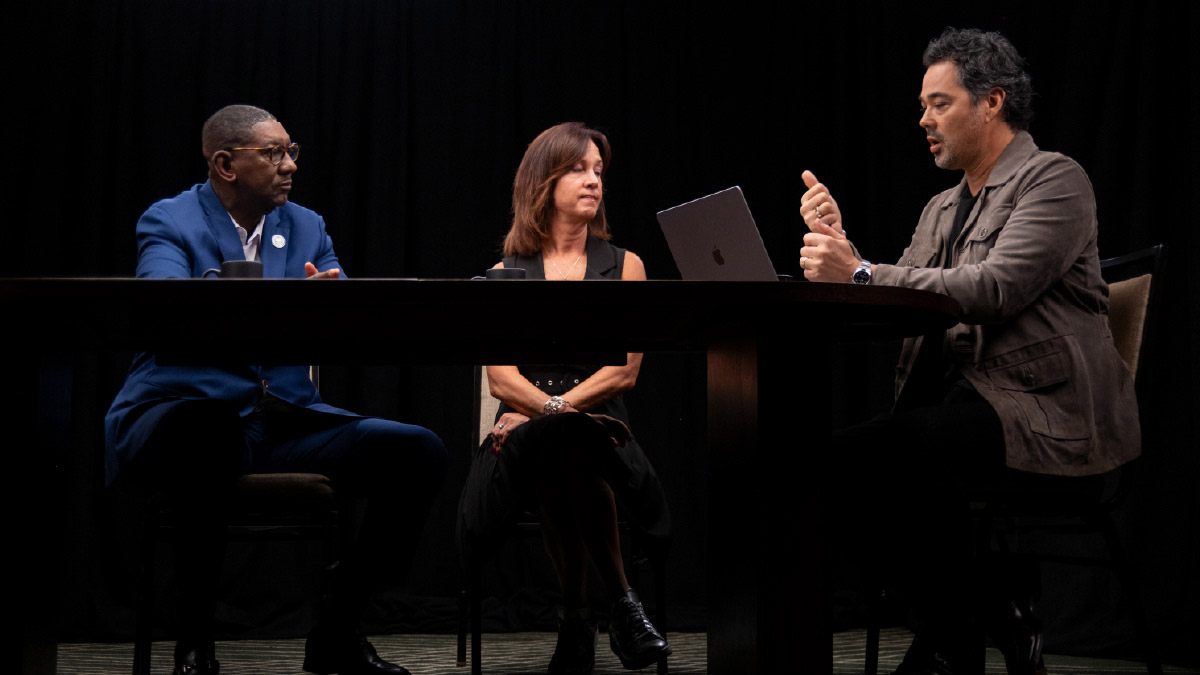
To that end, Cisco has released Season 1 of “Tech Unscripted,” a new video series centered on roundtable discussions with Cisco customers, sharing their experiences on the challenges they face — and the business outcomes that Cisco helps drive. To listen to the audio versions, visit Cisco Champion Radio.
Here are some key insights from the series:
Why invest in IT?
Investments in infrastructure are sometimes difficult to secure. In the Business of IT video installment, two key Cisco customers — Delaware State University and the town of Carey, N.C. — shared their experiences with digital transformation and the benefits that followed.
Nicole Coughlin, CIO of Carey, started with a few thoughts on creating a “living lab,” to demonstrate the impact that such investments could have on the town.
“In partnership with Cisco,” she said, “we were able to run either low cost or no cost pilots to demonstrate the use of technology."
And she stressed the importance of finding the right partner.
“As public-sector people, we cannot do it alone,” she said. “So, we need to have great partners. That’s kind of your golden nugget.”
Darrell McMillon, VP of IT and CIO of Delaware State University, added that while “change is tough,” having a clear picture of what technology can do — and who will benefit most from it — is critical.
“We’re always looking at that vision,” he said. “We’re trying to advance the students, trying to give them the opportunities that they need as they move forward and graduate.”
Building resilience
Downtime is the enemy of revenue, brand loyalty, and so much more. So, in a video centered on digital resilience, representatives from WWE, Customers Bank, and Carnival Cruise Lines, shared their thoughts. For these professionals, it starts with proactive monitoring tools, like Cisco ThousandEyes for network insights and Splunk for security and data correlation. And it extends to AI powered, platform-based solutions like Cisco AI Defense and Cisco AI Canvas, along with robust automation and standardization.
The panelist stressed the need to proactively and predictively detect and remediate problems as they occur, if not before.
“I think in wrestling terms, my superpower is to powerbomb any network threats that may be coming into our environment,” said Ralph Riley, director of IT broadcast systems for WWE. “Any network anomalies will get an elbow drop from me."
That level of resilience is essential for Dexter King, senior NetDevOps engineer for Carnival Cruise Lines.
“Outages for us are very severe,” he explained. “We can't just hop in the car and go to the building that's having the outage, because the building is quite literally in the middle of the ocean."
Of course, in the age of AI — and with constant security threats to critical data — establishing trust and maintaining transparency is essential.
“Customers understand if there's a problem, we’ll be communicating with them,” said Evan Mintzer, director of production infrastructure for Customers Bank. “They can be trusting us with millions or even more dollars. So, they have to have that trust in us."
AI-ready data centers
To handle the demands of AI, data centers need high-speed connectivity, massive scalability, and robust security (just for starters). And many legacy infrastructures are not equipped for this all-new paradigm.
In a spirited discussion, leaders from World Wide Technology, Microsoft, GE Aerospace, and GE Vernova shared key insights on the critical role of the data center in the AI era — and how they meet challenges ranging from executive buy-in and upskilling staff to cooling, energy, and bandwidth demands.
Micheline Murphy, senior consulting systems engineer, believes organizational commitment is among the most important factors.
“It requires a level of commitment from the organization that we are all going to go on this journey, and it's going to be painful,” she said, “because this is a new technology that's going to require a lot of different things from our data centers that today they're just not ready for.”
Rob Gastrich, senior staff infrastructure architect of GE Vernova, shared his own thoughts on being prepared for future demands.
“We need to make sure that our backbones can support the high demands that [AI] is going to be drawing on us,” he said. “But it’s an exciting time to be in the field,” he said.
The panelists also acknowledge that navigating this exciting potential will include upskilling, so that teams are prepared for the escalating demands of AI.
As Rustam Gaisin, senior engineer at Microsoft, put it: “The world is evolving, and you have to keep up or you're just going to be on the side.”
Building the future-proof workplace
The future of work is all about collaboration. And that means collaborating from within the office or from home, a café, or at 30,000 feet in the air. Increasingly, as agentic AI becomes an integral part of work it also means collaboration between humans and machines, and machines with other machines.
In a fourth video, experts from Cisco customers Northern Kentucky University, Innovation Federal Credit Union, and Winslow Technology Group, shared their thoughts.
Ryan Deppe, specialty solutions architect for Winslow Technology Group, described the ultimate goal.
"When you get to the point where your users don't notice a difference when they're working remotely or whether they're working in the office,” he said, “that's the perfect, ideal scenario."
Cisco refers to that ideal state as “distance zero,” and the company’s innovations are bringing customers closer to it than ever before.
But getting there can still be challenging.
For example, great collaboration demands … great collaboration. So, panelists stressed the need for seamless alignment between security, networking, and collaboration teams.
“You can do things in a bubble,” said Shawn Spurko, VP Information and Cyber Security at Innovation Federal Credit Union. “But that's not ever going to be future-proof, because you're thinking about the needs of your team, not the needs of everybody else."
In particular, Spurko stressed that security needs to be in the conversation from the beginning.
“As a security person,” he said, “I need IT people, developers, everybody else to understand, my job is not here to make your life difficult. If you include me at the end, that makes it difficult for everyone."
Greg Thompson, director of IT infrastructure and operations at Northern Kentucky University, summed up the benefits of making smart investments — and looking ahead to unexpected future challenges.
For example, he cited a decision to have three separate internet connections on campus, which paid off when two went down at once.
“Something that looked like it was an unnecessary cost,” he said, “ended up saving us tremendously.”