


“There will be two kinds of companies in the world,” said Jeetu Patel, Cisco’s president and chief product officer, “ones that are really good with AI, and ones that struggle for relevance.”
One reason for that struggle is inadequate infrastructure. AI’s demands for bandwidth, security, speed, and the energy to power it all are growing exponentially. And much of the legacy infrastructure can’t keep up.
The latest Cisco AI Readiness Index confirmed that just 28% of organizations believe their infrastructure can handle AI workloads. And those whose infrastructures can’t handle AI workloads are leaving potential value on the table. The same survey showed that among AI “pacesetters” — the 13 percent of companies that are fully prepared for AI — 91% are already increasing profitability.
Over the last year, Cisco has introduced an incredible amount of innovation, offering the industry’s most comprehensive range of scalable, programable infrastructure solutions to support all that’s possible with AI, whether for hyperscalers, neoclouds, service providers, or enterprises.
That includes the critical networking, compute, security, and observability foundations that power trusted AI deployment. And it extends to the expertise and intuitive interfaces (themselves powered by AI) that simplify AI transformation and accelerate the journey to value and innovation, especially as agentic AI continues its rise. Industry-leading partners like NVDIA and Microsoft — together with Cisco’s strategic investments in innovative AI startups like Mistral — complete the picture.
As Zeus Karravala, principal analyst at ZK Research, wrote earlier this year, “Cisco simplifies AI and security, two of the biggest pain points for information technology organizations. For a company the size of Cisco, it has shown a high level of nimbleness in transitioning their strategy.”
Tying it all together
As important as cloud has been in recent years, the private data center is critical to AI deployments. And at Cisco Live 2025 in San Diego, Cisco chair and CEO Chuck Robbins shared the company’s central role in redefining the data center.
“The private data center is back,” Robbins stressed. “And we want to help you to transform your data centers to power AI workloads, anywhere, and with seamless operations, observability, and security.”
Cisco’s comprehensive solutions are essential as data centers — and those who maintain and secure them — face unprecedented challenges.
New Cisco Nexus 9300 series smart switches feature embedded Data Processing units (DPUs) to steer data traffic more efficiently than ever before. Other solutions include Secure AI Factory, which was developed in partnership with NVIDA, expanded Cisco AI PODs, and a unified Nexus Dashboard that can help customers manage all of their data center fabrics in one place. Combine those with Cisco optics and the integration of Splunk and Cisco ThousandEyes for unprecedented observability and digital resilience, and capturing AI value looks a lot less complex and challenging.
Patel summed it up.
“We are driving this AI-ready data center build out by providing high-performance, low-latency, energy-efficient networking, compute, optical systems,” he said, “with security baked into the fabric of the network.”
Distributed data centers, acting as one
To meet the ever-increasing demands of AI, hyperscalers and web-scale organizations are connecting separate, far-flung data centers for expanded capabilities.
“AI compute is outgrowing the capacity of even the largest data center, driving the need for reliable, secure connection of data centers hundreds of miles apart,” said Martin Lund, EVP, Cisco’s Common Hardware Group.
However, it’s a strategy that creates additional new challenges, especially around latency and security. Here, too, Cisco is providing the critical solutions that make distributed AI workloads work.
Last month, Cisco announced its new Cisco 8223 router, the first 51.2 terabits per second (Tbps) Ethernet fixed router ready for the exponentially increasing AI workloads between data centers. At the heart of the 8223 is the Cisco Silicon One P200, the industry's only scalable and programmable unified networking architecture. This breakthrough innovation allows customers to use one system, powered by one chip to enable efficient scale-across networking, with the Cisco 8223 3 RU, 51.2 Tbps configuration consuming about 65% less power than prior generations.
“With the Cisco 8223, powered by the new Cisco Silicon One P200,” Lund added, “we’re delivering the massive bandwidth, scale, and security needed for distributed data-center architectures.”
Patel further explained the challenges that Cisco is meeting.
“We are able to take data centers that could be hundreds of kilometers apart and make them act as one logical compute unit,” he said. “We are able to do this because we have a 51.2 Tbps chip. And when that’s combined with our optics, a very meaningful solution comes out.”
For Patel, it’s all about meeting not just the demands of today but future proofing against what comes next.
“We are solving hard computer science problems,” he added, “to make sure that we can help build out the infrastructure that’s ready for the next wave.”
An AI future built on trust and resilience
Along with its amazing promise, AI garners no small amount of negative press. So, getting it right is a key concern for any organization. That means assuring customers, users, and employees that your AI is solid, secure, and resilient. Because without trust, capturing AI value is all but impossible.
“We want to make sure that the infrastructure we provide is resilient in nature,” Patel explained, “so that it's if you do have an outage, you can come back up and recover as quickly as possible.”
Cisco makes it all happen with tools like AI Defense, and end-to-end solution that protects both the development and use of AI applications. And the Secure AI Factory with NVIDIA protects the entire AI stack end to end, with built in security and observability, covering AI software, workloads, and infrastructure. The ongoing integration of Splunk, for real-time observability, and Cisco ThousandEyes for end-to-end assurance — further empower customers to see across their infrastructures and beyond, enabling them to isolate and remediate issues as they arise, if not before.
“ThousandEyes and Splunk are unique in our ability to truly see things from client to cloud,” said Joe Vaccaro, VP and GM of Cisco ThousandEyes, “to see it everywhere, across every core part of every segment, of every connection. And then be able to understand it in ways that allow us to move through detection, diagnosis, and remediation as quickly as possible.”
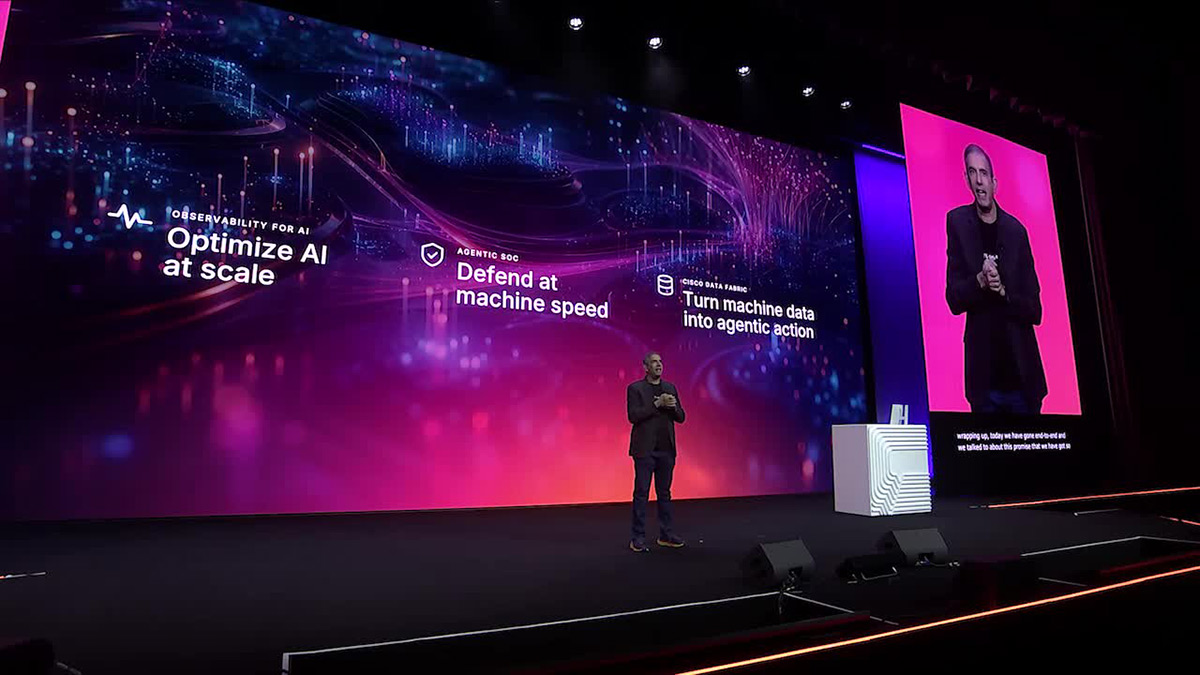
At Cisco Live 2025, Chuck Robbins summed up that strategy to a packed crowd.
“As you try to achieve these outcomes and build the infrastructure to be ready for AI, quantum, and whatever's next, you have to have security. You have to build it with integrity, and you have to build it with a consideration for humanity. And that's underpinned by trust. We want to partner with you to bring that vision to life.”